Steak Doneness Chart: Temps and Cook Times by Cut

By Luke Davidson · Modernist Cook · Published 2026-05-08
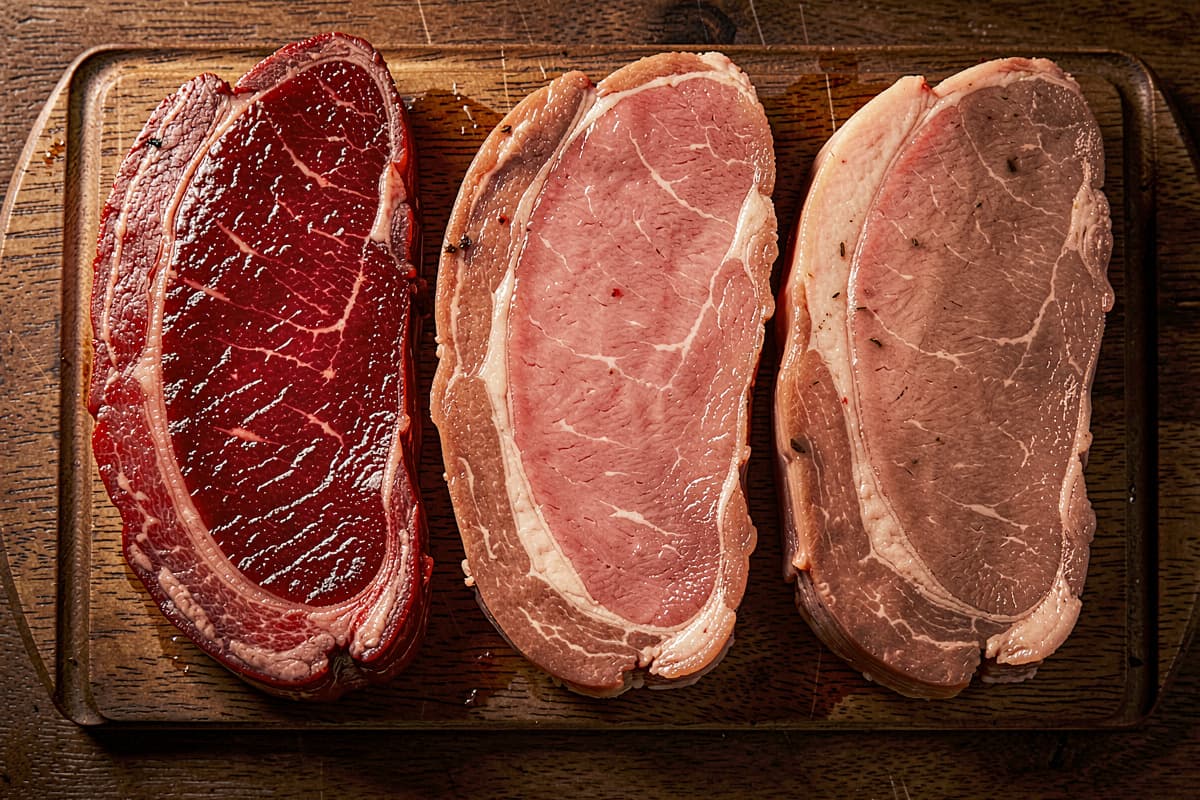
Steak doneness is set by internal temperature, with five standard tiers: rare (120°F / 49°C), medium-rare (130°F / 54°C), medium (140°F / 60°C), medium-well (150°F / 66°C), and well-done (160°F / 71°C). For ribeye, sirloin, strip, and most other whole-muscle steaks, medium-rare is the standard target — it preserves the marbling that gives premium cuts their flavor while still being warm in the center. Whole-muscle steaks are food-safe at any internal temperature once the surface is seared above 165°F, because surface bacteria are killed by the high-heat sear and the interior was never exposed to outside contamination. The table below lists temps, descriptions, and pan-sear times for 1-inch, 1½-inch, and 2-inch thick steaks cooked in a screaming-hot cast iron over high heat. Pull temperatures account for 5-7°F of carryover during the recommended 5-minute rest.
Steak doneness chart (cast iron, high heat)
| Doneness | °F | °C | Description | 1 in (per side) | 1½ in (per side) | 2 in (reverse sear) |
|---|---|---|---|---|---|---|
| Rare | 120 | 49 | Cool red center | 2 min | 3 min | Oven 250°F to 105°F + 90s/side sear |
| Medium-rare | 130 | 54 | Warm red center — standard target | 3 min | 4 min | Oven 250°F to 115°F + 90s/side sear |
| Medium | 140 | 60 | Warm pink center | 4 min | 5 min | Oven 250°F to 125°F + 90s/side sear |
| Medium-well | 150 | 66 | Slightly pink center | 5 min | 6 min | Oven 250°F to 135°F + 90s/side sear |
| Well-done | 160 | 71 | No pink, dry — not recommended for premium cuts | 6 min | 7 min | Oven 250°F to 145°F + 90s/side sear |
Doneness at a glance
Why steaks are different from ground beef
Ground beef and whole-muscle steak have different food-safety considerations. When meat is ground, surface bacteria (E. coli, salmonella) get distributed throughout the patty — this is why USDA recommends 160°F internal for ground beef.
Whole-muscle steak is sterile on the inside. The interior of a piece of muscle was never exposed to air or surface bacteria. As long as the surface gets seared above 165°F (which happens almost instantly in a hot pan), the steak is food-safe at any internal temperature, including very rare. This is why steakhouses serve steaks blue (115°F) and rare (120°F) without issue.
Pull-temp vs final temp for steaks
Steaks have larger thermal mass than burgers, so carryover cooking is more pronounced — typically 5-7°F during a 5-minute rest. To land at a target final temperature, pull at:
- 113°F to land at 120°F (rare) - 123-125°F to land at 130°F (medium-rare) - 133-135°F to land at 140°F (medium) - 143-145°F to land at 150°F (medium-well) - 153-155°F to land at 160°F (well-done)
The larger the steak, the more carryover. A 2-inch tomahawk can rise 8-10°F during rest; a thin 1-inch flank steak rises only 3-4°F.
Reverse sear for 2-inch+ thick cuts
Steaks thicker than 1½ inches benefit from the reverse sear: cook low in the oven (250°F) to about 15°F below your target internal temp, then finish with a hard sear in a screaming-hot pan for 60-90 seconds per side.
The reverse sear gives you a more even pink interior (no gray ring around the edges) and a deeper crust because the surface is dried out by the oven phase. It's the right method for tomahawk, porterhouse, and any steak over 1.5 inches thick. For thinner steaks, traditional pan-sear is faster and produces equivalent results.
Resting (the most-skipped step)
After cooking, rest the steak for 5 minutes for a 1-inch cut, 7-8 minutes for 1½-inch, and 10 minutes for 2-inch+. Skip resting and the juices haven't redistributed — your first cut releases all the moisture onto the cutting board.
During rest, internal temperature continues to rise (carryover) and the muscle fibers relax, holding their juices when sliced. The reward for 5 minutes of waiting is dramatically more visible: a properly rested medium-rare steak loses 30-50% less juice when cut than a steak rested only 60 seconds.
Frequently Asked Questions
What temperature is medium-rare steak?
130°F (54°C) internal. Pull from heat at 123-125°F to account for 5-7°F of carryover during a 5-minute rest. This is the standard professional target for ribeye, sirloin, strip, filet, and most premium cuts.
Is medium-rare steak safe to eat?
Yes. Whole-muscle steaks are food-safe at any internal temperature as long as the surface has been seared above 165°F. The interior of a steak was never exposed to outside air or surface bacteria, so internal pinkness doesn't carry illness risk. This is different from ground beef, where bacteria get distributed throughout.
How long do you cook a 1-inch steak per side?
On high heat in a cast iron pan: 2 minutes per side for rare, 3 minutes for medium-rare, 4 minutes for medium, 5 minutes for medium-well, 6 minutes for well-done. Add 1 minute per side for each additional half-inch of thickness.
Should I rest steak before or after cooking?
Both. Pull the steak from the fridge 30-60 minutes before cooking (room-temp meat sears better than cold meat). After cooking, rest 5 minutes for a 1-inch steak — this lets juices redistribute and accounts for carryover cooking.
Why is my steak gray on the outside before the crust forms?
The pan is too cold or the steak surface is too wet. For a deep crust to form in 3-4 minutes, the pan needs to be smoking-hot (450°F+) and the steak surface needs to be dry — pat it with paper towels right before it goes in. Salting 40+ minutes ahead helps draw moisture out and dry the surface.
You Might Also Like
A perfectly seared ribeye basted in golden butter — the king of carnivore dinners. 48g protein and 42g fat per 10 oz cooked. Pull at 130°F medium-rare.
ComparisonA detailed head-to-head comparison of ribeye and sirloin steaks covering macros, micronutrients, flavor profiles, and cost per pound.
ComparisonFind out how tomahawk and ribeye steaks compare in nutrition, size, cooking method, and price. Are you paying more just for the bone?