Is Beef Jerky Carnivore? (Yes — Here's What to Look For)

By Tyler Thompson · Long-Term Carnivore Advocate · Updated 2026-05-14
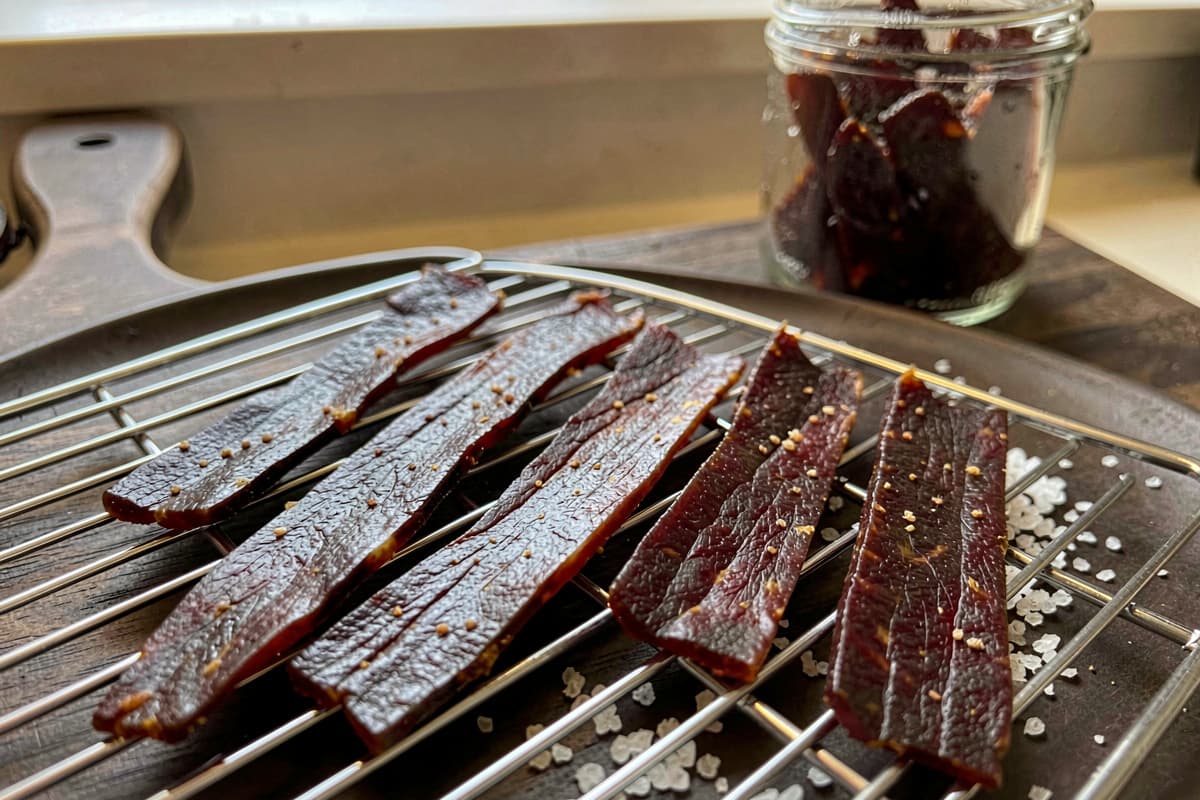
Beef jerky is carnivore-aligned IF it's made from meat and salt with no soy sauce, sugar, Worcestershire, or seed oils. The catch is that 95% of commercial jerky fails this test — most brands use sugar or brown-sugar-based rubs, plus soy or Worcestershire for umami. Strict carnivore eaters either buy from a small list of meat-and-salt-only brands (Carnivore Crisps, Brave Foods, Paleovalley) or make their own. Macros per ounce of clean jerky: 16-18g protein, 1-3g fat, 0g carbs, 90-110 calories. Cost: $5-8 per ounce retail for clean brands, or $3-4 per ounce home-made from top round. The home recipe takes 5 hours of unattended dehydration at 165°F, no special equipment beyond an oven or a basic dehydrator. Plains-Indian pemmican (dried beef ground with rendered tallow) is the older, longer-shelf-stable cousin of jerky — also carnivore-aligned with similar ingredients-checking. If you want the recipe with no soy, no sugar, no Worcestershire: the homemade-beef-jerky-no-sugar recipe on this site walks through the full method.
What makes jerky carnivore-aligned
Three rules. First, only meat and salt — anything else needs label-checking. Second, the meat should be a single cut (top round, eye of round, sirloin) not 'mechanically separated beef' or 'beef trim.' Third, the dehydration method should be heat or air, not chemical preservatives.
Ingredients to avoid on the label: soy sauce, tamari, Worcestershire, brown sugar, cane sugar, dextrose, maltodextrin, honey, molasses, vinegar (some carnivore frameworks allow it, strict does not), seed oils, MSG, natural flavors (often a code for plant-derived flavoring), and 'cultured celery powder' (a sneaky nitrate source from plant matter).
Ingredients that are fine: beef (or pork, lamb, venison, etc.), salt, sodium nitrite (a preservative also used in bacon — many strict carnivore eaters accept it). Black pepper is excluded under strict carnivore but accepted by most non-strict frameworks.
Brands that are actually carnivore
Three brands consistently meet the meat-and-salt-only standard as of 2026: Carnivore Crisps (single-cut beef, salt, beef tallow), Brave Foods Brave Bites (beef, salt, beef tallow), and Paleovalley Beef Sticks (varies by flavor — check labels; their plain salt version is clean).
Brands that look carnivore but FAIL the strict test: Chomps (most flavors have celery powder), Country Archer (uses cane sugar in most lines), Epic Provisions (uses honey and rice flour as binders), Jack Link's (sugar + soy sauce in nearly every variant).
The cleanest place to buy is direct from small grass-fed-beef operations — Force of Nature, US Wellness Meats, and local butchers often make a salt-only jerky on request. Cost runs $6-10 per ounce. Home-made is half that.
Why home-made wins on cost and control
Two pounds of top round runs $14-22 at standard grocery stores ($7-11 per pound). After dehydration the yield is about 12-14 ounces of finished jerky, putting raw cost at roughly $1-2 per ounce — one-third the price of clean commercial brands.
The time investment is 30 minutes of slicing and salting plus 4-5 hours of unattended drying. A standard oven on its lowest setting (170-175°F) works without a dedicated dehydrator. Slice the meat across the grain into ⅛-inch strips, toss with 1 tbsp coarse salt per 2 pounds, lay flat on wire racks, dehydrate until the strips bend without snapping.
Storage: 1 month in airtight containers at room temperature, 6 months refrigerated, indefinitely in vacuum-sealed freezer bags. The full method with timing notes is in the homemade-beef-jerky-no-sugar recipe.
Pemmican: jerky's older, denser cousin
Pemmican is dried meat (jerky) ground to powder and mixed 1:1 by weight with rendered animal fat (beef tallow or lard). It was the original North American travel food for Plains Indians and 18th-century fur traders — shelf-stable for 6+ months unrefrigerated.
Macros per 2-ounce bar: 16g protein, 30g fat, 340 calories. It's much more calorie-dense than plain jerky because of the fat content. Two pemmican bars cover a hiking lunch; four cover a day.
Traditional pemmican often included dried berries (saskatoon, chokecherry) for flavor — those are excluded under strict carnivore. The strict version is meat powder + tallow + salt, period. See the pemmican-carnivore recipe on this site for the full assembly process. The math: 6 oz of dried jerky + 6 oz of rendered tallow = 8 bars of 2 oz each.
Frequently Asked Questions
Is jerky allowed on carnivore?
Yes — if it's meat and salt only with no soy sauce, sugar, or seed oils. Most commercial brands fail that test. Home-made jerky or a small number of clean brands (Carnivore Crisps, Brave Foods, US Wellness) pass.
What's the difference between jerky and biltong?
Cooking method. Jerky is heat-dried (165°F oven or dehydrator) for hours. Biltong is air-dried at room temperature for days. Biltong tends to be thicker and softer-chew; jerky is thinner and more brittle. Both are carnivore-aligned when made with salt only.
Does jerky have carbs?
Clean carnivore-style jerky (meat + salt only) has 0g carbs. Most commercial brands have 3-8g carbs per ounce due to added sugar and starches. Check the nutrition label and the ingredients list separately — some products labeled '0g sugar' still have starch fillers that contribute carbs.
Can I eat jerky daily on carnivore?
Yes. Some carnivore eaters use jerky as their primary snack and eat 1-3 ounces per day. The sodium load is high (jerky is salt-cured) but carnivore diets generally need MORE salt than non-carnivore diets, so it's not a problem for most people. If you have specific blood-pressure concerns, monitor and adjust.
How long does homemade jerky last?
1 month at room temperature in airtight containers. 6 months refrigerated. 1+ year vacuum-sealed and frozen. The lean meat with low moisture and high salt is naturally pathogen-resistant — Plains Indians stored jerky and pemmican through entire winters without refrigeration.
You Might Also Like
2 lb top round sliced thin, salted, dehydrated at 165°F for 4-5 hours. Strict carnivore — no soy sauce, no Worcestershire, no brown sugar. $3.50 per oz.
RecipeTraditional Plains-Indian preserved food: dried beef ground fine, mixed 1:1 with rendered tallow. Lasts 6+ months unrefrigerated. Salt only.
RecipeSouth African air-dried beef. Top round salt-cured 24 hours, hung to air-dry 4-7 days. Salt only — no vinegar, no coriander. The strict-carnivore biltong.