Carnivore Diet vs Paleo: How They Differ

By Patrick Murphy · Animal-Based Crossover Writer · Published 2026-05-08
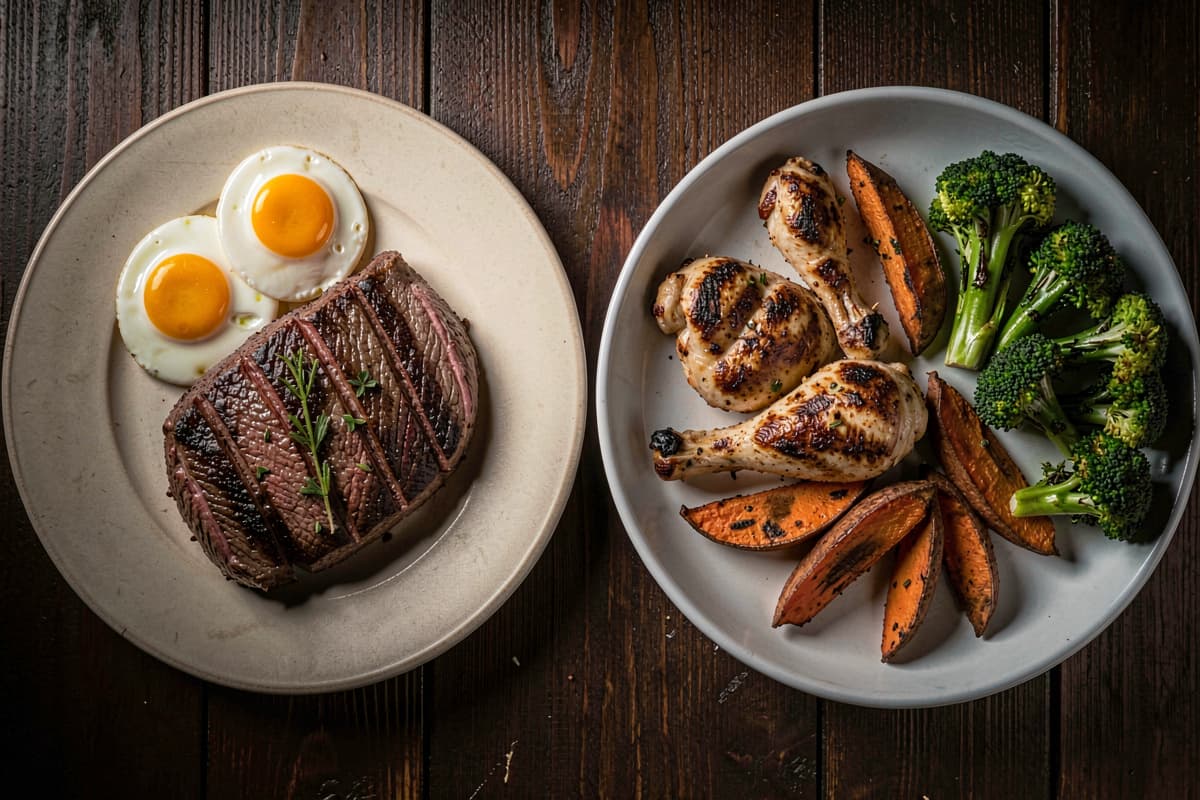
Paleo and carnivore both reject grains, legumes, refined sugars, processed seed oils, and modern processed foods, but the diets diverge sharply on plant inclusion. Paleo permits all whole-food plants — vegetables, fruits, nuts, seeds, tubers, herbs, and spices — alongside meat, fish, and eggs. Carnivore excludes all plant foods entirely and eats only animal products. Both diets are built around the premise that human metabolism is best matched to ancestral whole foods, but they interpret 'ancestral' differently: paleo as the broad hunter-gatherer diet that included substantial plant intake, and carnivore as the high-meat protocol that some hunter-gatherer populations (Inuit, Maasai during dry seasons) actually ate. Most people on either diet succeed for similar reasons — eliminating processed food, refined sugar, and seed oils — but the philosophical framing and day-to-day food list look quite different.
Macro split and carb tolerance
Paleo. Variable. Often 30-40% protein, 30-40% fat, 30-40% carbs. Many paleo eaters consume 100-200g carbs per day from sweet potatoes, fruits, vegetables, and honey. Some paleo eaters run lower-carb (under 50g) by emphasizing meat and leafy greens; this is sometimes called 'low-carb paleo.'
Carnivore. 70-80% fat, 20-30% protein, 0-1% carbs. Hard floor on carbohydrate intake.
The two diets typically differ in body composition outcomes. Paleo often produces moderate weight loss but rarely the deep ketosis carnivore produces. Carnivore reliably produces ketosis; paleo at higher carb levels does not.
What paleo includes that carnivore excludes
Vegetables. All non-nightshade vegetables on paleo — leafy greens, cruciferous (broccoli, cauliflower, cabbage), root vegetables (carrots, beets, sweet potatoes), squash. Carnivore excludes all of these.
Fruits. All whole fruits on paleo, including high-sugar fruits (mangoes, bananas, dates) in moderation. Carnivore excludes fruit entirely.
Nuts and seeds. Almonds, walnuts, macadamias, cashews, pumpkin seeds, sunflower seeds — all paleo. None on carnivore.
Tubers. Sweet potatoes, yams, taro — paleo staples for athletes. Excluded on carnivore.
Honey and maple syrup. Allowed on paleo as ancestrally available sweeteners. Excluded on strict carnivore (animal-based version of carnivore allows honey).
Herbs and spices. Garlic, ginger, turmeric, oregano, salt — broadly paleo. Strict carnivore excludes everything except salt; practical carnivore eaters often allow a small amount of black pepper or paprika.
Why people switch between the two
Paleo → carnivore. Common when paleo isn't producing the symptom relief expected — particularly for autoimmune conditions, IBS, eczema, or persistent inflammation. The reasoning is that paleo still includes plant compounds (lectins from legumes, oxalates from leafy greens, salicylates from herbs) that may be drivers; carnivore removes them all to test.
Carnivore → paleo. Less common, usually after 6-12 months of carnivore when the eater wants to reintroduce variety while keeping the principles intact. Done as a slow reintroduction: first cooked vegetables, then fruits, then nuts, watching for symptoms.
Frequently Asked Questions
Is carnivore considered a type of paleo?
Sometimes called 'extreme paleo' or 'paleo zero,' but most carnivore practitioners distinguish the two. Paleo is built around variety and ancestral plant inclusion; carnivore is specifically about removing all plant foods. The framing is different even though they share the rejection of grains, sugar, and seed oils.
Which is healthier — carnivore or paleo?
There's no consensus answer. Paleo has more research backing for long-term cardiovascular and metabolic health. Carnivore has more anecdotal evidence for autoimmune symptom relief. The 'healthier' diet depends on your specific goals: paleo for general nutrition optimization, carnivore for elimination and testing.
Can I do paleo and carnivore at the same time?
Yes — that's effectively 'low-carb paleo' or 'paleo zero,' which means eating paleo-allowed foods but skipping the high-carb plants (tubers, fruits) and emphasizing meat. Some people land here naturally as a long-term sustainable framework.
Does paleo or carnivore have better long-term research?
Paleo has substantially more peer-reviewed research, particularly for metabolic syndrome, type 2 diabetes, and cardiovascular markers. Carnivore is under-researched in formal clinical trials but has thousands of self-reported case studies on Reddit, podcasts, and patient registries.
Can carnivore eaters call themselves paleo?
Technically yes — carnivore is a strict subset of paleo (everything carnivore eaters consume is also paleo-approved). But the framing differs enough that most people in the carnivore community don't identify as paleo.